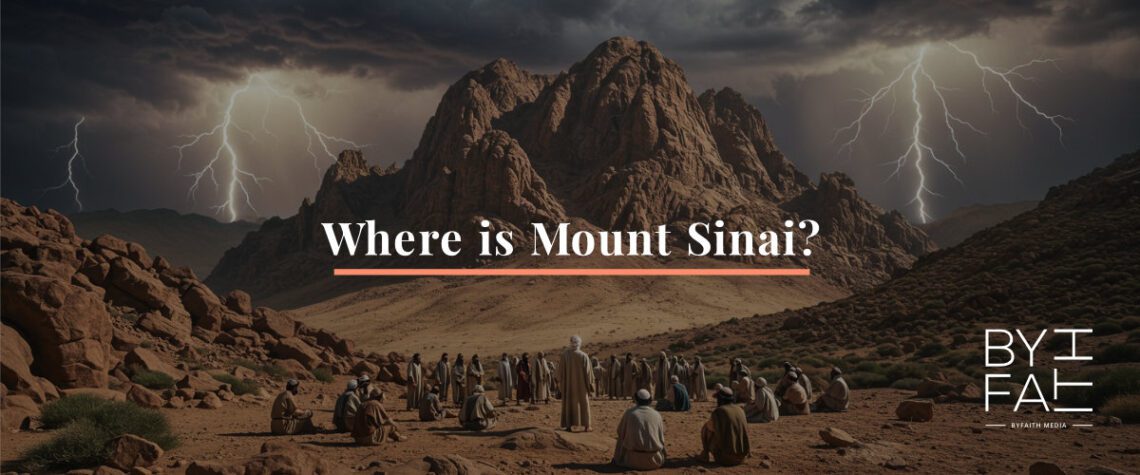
Mount Sinai in Saudi Arabia, Jabal al-Lawz, Fake or True?
Is the iconic Mount Sinai, the very place where Moses received the Ten Commandments, located in the Sinai Peninsula as traditionally believed or does it lie in Saudi Arabia? What does the Bible say and how can we separate popular myths from biblical reality?
After they set out from Rephidim, they entered the Desert of Sinai and Israel camped there in the desert in front of the mountain
– Exodus 19:2
The following arguments for the location of Mount Sinai are rooted in biblical, historical, geographical and archaeological analysis, and will show that the Bible refutes Saudi Arabia as the location of Mount Sinai.
Hiking Mount Sinai in the Snow. Walk the Bible, EP 15
Galatians 4:25 Misinterpretation
Advocates often cite Paul’s statement that ’Mount Sinai is in Arabia’ (Galatians 4:25) to support a Saudi location, but Paul did not use a twenty-first-century map! In the first century, ’Arabia’ was a broader Roman term that included the Sinai Peninsula and some parts of modern Jordan and Saudi Arabia.
Paul places Sinai in ‘Arabia,’ but that term’s meaning has drastically shifted in 2000 years. To claim a ‘Saudi Sinai’ based on Galatians is to forget the historical understanding of that word in the maps the Romans used
Based on historical records, the Sinai Peninsula was considered a part of Arabia during the first century, making Apostle Paul’s geographical description entirely accurate. Ancient historians like Herodotus, Pliny and Strabo defined Arabia’s borders broadly, stretching all the way from the Persian Gulf to the Nile Delta. Under this specific classical definition, the Sinai Peninsula fell directly within Arabian territory, which aligns perfectly with Paul locating Mount Sinai there.
Geographical Challenges
Jabal al-Lawz in Saudi Arabia has been claimed as Mount Sinai, but it is located over 200 miles (320 kilometres) from the Gulf of Aqaba’s Nuweiba Beach, the proposed Red Sea crossing site in this theory. This distance poses significant logistical issues for a large group of Israelites, including women, children and livestock, to travel in a short time frame, especially given the rugged terrain and lack of water sources along the way.
They left Rephidim and camped in the Desert of Sinai
– Numbers 33:15
Also, the biblical names describing the route do not correspond with the ancient names used in Saudi Arabia, nor does the time to travel follow the narrative in Scripture. In contrast, the Sinai Peninsula route aligns better with a manageable journey following the step-by-step guidance in the Book of Exodus.
The Blackened Peak of Jabal al-Lawz
Proponents point to features like a blackened mountaintop of Jabal al-Lawz in Saudi Arabia (attributed to God’s descent in fire), a split rock (linked to water from Horeb), and petroglyphs of cattle (tied to the golden calf incident) as evidence. However, the blackened peak of Jabal al-Lawz is naturally occurring volcanic rock or weathered basalt, not evidence of a supernatural event, and scientific analysis does not support claims of scorching. The split rock is also a common geological formation and lacks inscriptions or artefacts tying it to the Exodus.
Jabal al-Lawz mountain fails under scrutiny: archaeology, science and Scripture disagree
In addition, the cattle petroglyphs predate the Exodus (estimated 1446 BC or later) by centuries and are linked to earlier cultures, not Israelites. Similarly, alleged altars and pillars date to the Nabatean period (centuries later) and are unrelated to Moses.
The Sea of Reeds
The Red Sea is more aptly translated as ’Sea of Reeds’ (Yam Suph) and is best understood within the context of ancient Egypt’s eastern Nile Delta. This region was replete with shallow lakes, lagoons and marshlands, ideal for the growth of reeds and papyrus, aligning with the Hebrew term’s interpretation.
When Pharaoh let the people go, God did not lead them by way of the land of the Philistines, although that was near… But God led the people around by the way of the wilderness toward the Red Sea [Sea of Reeds]
– Exodus 13:17-18
Given the Exodus narrative, it’s plausible the Israelites traversed such a body of water as they fled Egypt eastward, placing the Sea of Reeds within the geographical boundaries of the ancient Egyptian landscape. The ’Red Sea’ (Yam Suph) ’Sea of Reeds’ was deep enough to drown in and shallow enough to part easily. This sets the initial trajectory toward the Sinai Peninsula, not a distant crossing into Saudi Arabia.

Route of the Exodus
The traditional route of the Exodus, as described in Exodus and Numbers, suggests a journey from Egypt through the Sinai Peninsula, not across the Gulf of Aqaba into Saudi Arabia. Sites like the Desert of Shur (Exodus 15:22) and Marah are located in the Sinai Peninsula, not east of the Gulf of Aqaba. The Saudi Arabia theory requires a crossing at Nuweiba Beach on the Gulf of Aqaba, which lacks clear biblical support and introduces unbiblical logistical challenges for millions of Israelites.
The Amalekites’ Homeland
The Israelites fought the Amalekites within the Mount Sinai region (Exodus 17:8-16). Historical records, including those from Jewish historian Josephus, place Amalekite territory in the Sinai Peninsula and southern Canaan, not in northwestern Saudi Arabia. Positioning Mount Sinai in Saudi Arabia would require reinterpreting Amalekite territory implausibly far east.
Then Amalek came and fought with Israel at Rephidim
– Exodus 17:8-13
In Scripture, the Amalekites are described as dwelling in the Negev and Sinai regions (Numbers 13:29, 1 Samuel 15:7). As we have seen, their attack on Israel near Mount Sinai (close to Rephidim) supports a location in or near the Sinai Peninsula, not in Saudi Arabia, where Amalekite presence is unattested.
Mount Sinai in Scripture
The case against Mount Sinai being located in Saudi Arabia, particularly at Jabal al-Lawz (or sometimes Jabal Maqla), hinges on several key arguments that challenge the claims made by proponents of this theory. Hobab, a Midianite, wants to return to Midian, distinct from where the Israelites are at Sinai. Since Midian is east of the Gulf of Aqaba (in modern Saudi Arabia), this implies Sinai is west of Midian, in the Sinai Peninsula.
Moses said to Hobab the son of Reuel the Midianite, Moses’ father-in-law, ‘We are setting out for the place of which the Lord said, “I will give it to you.” Come with us…’
He said to him, ‘I will not go. I will depart to my own land [Midian] and to my kindred’ ”
– Numbers 10:29-31
The Midian Confusion
Some proponents argue that Mount Sinai must be in Saudi Arabia because Moses fled to Midian (Exodus 2:15), which is generally located in northwestern Saudi Arabia and later encountered God at the ‘mountain of God’ (Exodus 3:1). However, as we have found the Bible indicates that Mount Sinai and Midian are distinct locations.
Jethro, Moses’ father-in-law, together with Moses’ sons and wife, came to him in the wilderness, where he was camped near the mountain of God… and Jethro returned to his own country
– Exodus 18:5, 27
In Exodus chapter 18, Moses’ father-in-law leaves Midian to visit Moses at Mount Sinai. The Bible says, ‘Then Moses let his father-in-law depart [from Mount Sinai], to his own land [Midian].’
The Wilderness of Sin
The Wilderness of Sin is traditionally identified in the southwestern Sinai Peninsula. Its position ’between Elim and Sinai’ suggests Mount Sinai is a reasonable distance from Elim (likely near the Gulf of Suez), fitting a peninsula location rather than a far-off Saudi site.
They set out from Elim and all the congregation of the people of Israel came to the wilderness of Sin, which is between Elim and Sinai, on the fifteenth day of the second month after they had departed from the land of Egypt
– Exodus 16:1
No Archaeological Evidence
A group of potentially two million Israelites camping at Mount Sinai for over a year would leave significant archaeological traces, pottery, tools, or encampment signs. No such evidence exists at Jabal al-Lawz, unlike the Sinai Peninsula, where some sites show ancient activity consistent with the period.
- Why Scientists Think God Could Exist
- Abolishing Childhood, The Age of Innocence
- Is Being Woke Christian or Antichrist?
- Homosexuality and the Collapse of Society
- What Has Gone Wrong with the West?
- What is a Woman? And why it Matters
- Stock Market Crash – The Everything Bubble
- Electric Vehicles are not Eco-Friendly
- Climate Activists and Tantrums
- Climate Change Hypocrisy!
- Reparations Have Been Paid For Slavery
- How Civilisations Collapse, the West
- Jordan Peterson and the Quest for a Mentor
- Why Believing in God Makes Sense
- Can Boys Become Girls? Gender Dysphoria
- Borders are Good! The Bible, Immigration
- The Forgotten White Slaves of History
- Cancel Culture and Faith: Is Woke Broke?
- The Collapse of the United States
- Make 1984 Fiction Again: George Orwell, 666
- Why is the Church in Decline in Britain?
- BBC Bias and its Christian Foundation
- Christianity and Art
- Christianity and Culture
- Christian Book Reviews
- Can we Trust Scientists
Historical and Scholarly Critique
The traditional Mount Sinai site at Jabal Musa in the Sinai Peninsula has a long-standing identification dating back to at least the 4th century AD, associated with early Christian pilgrims like Egeria and the establishment of Saint Catherine’s Monastery. The Saudi theory is modern, stemming from flawed adventurers like Ron Wyatt in the 1980s, whose claims make sensational TV (e.g., finding Noah’s Ark, and Egyptian chariot wheels) but are discredited by research and scholars.
Scholarly Consensus
The Saudi theory relies heavily on speculative interpretations rather than peer-reviewed research, and the claims are made upon feelings and beautiful images. Most biblical scholars and archaeologists reject Jabal al-Lawz, favouring a Sinai Peninsula location (e.g., Jabal Musa or Jabal Sin Bishar) or acknowledging that the exact site may be unknowable due to limited textual and material evidence.
Visual Appeal Over Substance
The Saudi theory’s popularity, boosted by YouTube documentaries, relies on striking visuals (e.g., a burned peak, split rock) that appeal to lay audiences but crumble under scrutiny. These are false leads that prioritise sensation over Scripture or science.
Itinerary Supports the Sinai Peninsula Route
The detailed itinerary in the Bible lists stops like Etham and Marah, placed in the Sinai Peninsula by tradition and ancient writings. No biblical station clearly points to a crossing of the Gulf of Aqaba or a Saudi destination, aligning the journey with a peninsula-based Sinai.
They set out from Rameses… camped at Succoth… Etham, which is on the edge of the wilderness… Pi-hahiroth, between Migdol and the sea… Marah… Elim
– Numbers 33:3-15

Eleven Days from Horeb to Kadesh-Barnea
Kadesh-Barnea is widely identified in the northeastern Sinai Peninsula (near modern Israel-Jordan borders). An 11-day journey (about 100-150 miles at a slow pace with livestock) from Horeb (Sinai) fits a location in the southern Sinai Peninsula, such as Jabal Musa, but is too short for a Saudi site like Jabal al-Lawz (over 300 miles away).
It is eleven days’ journey from Horeb by the way of Mount Seir to Kadesh-Barnea
– Deuteronomy 1:2
Conclusion
The case against Mount Sinai being in Saudi Arabia, specifically at Jabal al-Lawz, rests on its failure to align with the biblical narrative, geographical feasibility and archaeological evidence. The theory appears driven more by modern speculation and visual allure than by a coherent synthesis of ancient texts and historical data. In contrast, the traditional location in the Sinai Peninsula, while not definitively proven, better fits the Scriptural journey, historical context and scholarly analysis. Ultimately, the exact location of Mount Sinai remains uncertain and the archaeological claims are polemical, but the Saudi Arabia hypothesis faces significant hurdles that undermine its credibility.
By Paul Backholer. Find out about Paul’s books here.