The Kings of England and the Mystery of their Graves: Why are they Buried in so many Places?
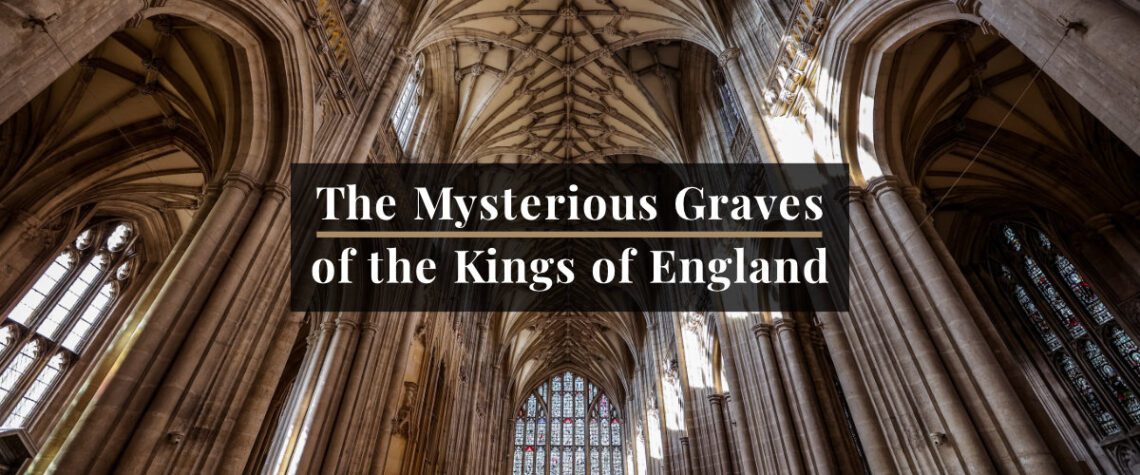
On my tours of ancient English churches, cathedrals and monasteries, I stumbled on something momentous. You turn a corner in a religious building and suddenly there is it, an effigy of a King of England with the statement: Here lies…King of England. I’ve visited the sites of the burials of forty-two kings of England (or Wessex) and each location tells a story about England or Britain, in that period of time.
His servants buried him in his tomb with his fathers
– 2 Kings 9:28
The chronicles of the burials of the ancient Kings of England and the kingdoms which foreshowed England narrate a curious story. We think of England as one nation within the United Kingdom of Great Britain, but the ancient kingdoms of the Britons were a movable feast.
Towns and later cities claimed to be the centre of power, but as the sands of time shifted, so did the burial places of the kings of England. If you walk around the corner from Corfe Castle in Dorset, there’s a sign declaring King Edward was murdered at this spot. It’s a shocking confession for a tiny sign to declare. In AD 978, the most powerful man in England was killed here and everybody just walks past.
When I walked through the ruins of Shaftesbury Abbey, I couldn’t imagine the impressive ceremony which took place in 979, when a great king was buried there. The body of King Edward the Martyr (962-978) was first buried at Wareham in haste, but it was moved to Shaftesbury Abbey.
Edward’s successor, King Æthelred the Unready (966-1016) was buried in Old St Paul’s London, which was destroyed in the great fire of 1666. In this brief period, power shifted and London became the centre for the burial of future Kings of England; something we are familiar with today.
After a period of war and foreign rule in the ancient kingdoms in Britain, the House of Wessex emerged victorious, and King Æthelred’s younger son Edward the Confessor (1003-1066), commissioned the building of Westminster Abbey in London.
The first Westminster Abbey was commissioned to be a royal burial church, which was consecrated on 28 December 1065. But in 1245, it was demolished for King Henry III’s larger building, which still stands.
The first king of all England earned this title because he stabilised England, defeating the Viking invaders and unifying the older diverse kingdoms under his rule. Originating from the Kingdom of Wessex, King Athelstan (895-939), was the grandson of King Alfred the Great and was the x30 great-granduncle to Queen Elizabeth II. Our late Queen was also the x24 granddaughter of William the Conqueror.
This is the book of the genealogy
– Genesis 5:1
In the list below, the burial places of the Kings of England (and the monarchs of kingdoms that predate England), the date of their death and the ever-changing locations for the burials and memorials are noted.
Winchester Cathedral
- Cynegils, 643
- Cenwalh, 672
- Egbert, 839
- Aethelwulf, 855
Sherborne Abbey
- Aethelbald, 860
- Aethelbert, 866
Wimborne Minster
- The First Lost Grave – Aethelred I, 871
- The Tomb is lost, but the site is known.
Hyde Abbey, Winchester
- The Second Lost Grave – Alfred the Great, 899.
- Edward the Elder, 924
- Malmesbury Abbey
The first King of all England, Hyde Abbey, Winchester
- Athelstan, 939
Glastonbury Abbey
- Edmund I, 946
Winchester Cathedral
- Eadred, 955
- Eadwig (Edwy), 959
Glastonbury Abbey
- Edgar, 975
Shaftesbury Abbey
- Edward the Martyr, 978
Old St Paul’s Cathedral
- Aethelred the Unready, 1016
Glastonbury Abbey
- Edmund Ironside, 1016
Roskilde Cathedral, Denmark
- Sweyn Forkbeard, 1014
Winchester Cathedral
- Cnut the Great, 1035
St Clement Danes, London
- Harold Harefoot, 1040
Winchester Cathedral
- Harthacnut, 1042
Westminster Abbey
- Edward the Confessor, 1066
Waltham Abbey / Bosham
- The Third Lost Grave – Harold Godwinson, 1066
Abbaye-aux-Hommes, Caen
- William the Conqueror, 1087
Winchester Cathedral
- William II (Rufus), 1100
Reading Abbey
- The Fourth Lost Grave – Henry I, 1135
Faversham Abbey / St Mary of Charity Church
- The Fifth Lost Grave – King Stephen, 1154
Rouen Cathedral
- Empress Matilda, 1167
Fontevraud Abbey
- Henry II, 1189
- Richard I, 1199
Worcester Cathedral
- John, 1216
Westminster Abbey
- Henry III, 1272
- Edward I, 1307
Gloucester Cathedral
- Edward II, 1327
Westminster Abbey
- Edward III, 1377
- Richard II, 1400
Canterbury Cathedral
- Henry IV, 1413
Westminster Abbey
- Henry V, 1422
Windsor Castle, St George’s Chapel
- Henry VI, 1471
- Edward IV, 1483
Westminster Abbey
- Edward V, c. 1483
- The Sixth Lost Grave, presumed bones
Grey Friars Priory, Leicester / Leicester Cathedral
- Richard III, 1485
- The Seventh Lost Grave, rediscovered 2012
Westminster Abbey
- Henry VII, 1509
Windsor Castle, St George’s Chapel
- Henry VIII, 1547
Westminster Abbey
- Edward VI, 1553
Tower of London
- Lady Jane Grey, the nine-day Queen, 1554
Westminster Abbey
- Mary I, 1558
- Elizabeth I, 1603
- James VI and I, 1625
Windsor Castle, St George’s Chapel
- Charles I, 1649
- The Eighth Lost Grave. His vault was lost and found in 1813.
Westminster Abbey
- Oliver Cromwell, Lord Protector, 1658
- The Nineth Lost Grave exhumed 1660, reburied in a pit at Tyburn, London.
All Saints Church, Hursley, Hampshire
- Richard Cromwell, Lord Protector, 1712
Westminster Abbey
- Charles II, 1685
Chapel of St Edmund, Church of the English Benedictines, Paris
- James II, 1701
- The Tenth Lost Grave, destroyed in the French Revolution
Westminster Abbey
- Mary II, 1694
Westminster Abbey
- William III and II, d. 1702
- Anne, 1714
Chapel of Leine Castle in Hanover, Germany
- George I, 1727
Westminster Abbey
- George II, 1760
Windsor Castle, St George’s Chapel
- George III, 1820
- George IV, 1830
- William IV, 1837
Frogmore, Royal Mausoleum
- Victoria, 1901
Windsor Castle, St George’s Chapel
- Edward VII, 1910
- George V, 1936
Frogmore, Royal Mausoleum
- Edward VIII, 1972
Windsor Castle, St George’s Chapel
- George VI, 1952
- Elizabeth II, 2022
Those from among you shall build the old waste places; you shall raise up the foundations of many generations; and you shall be called the Repairer of the Breach, the Restorer of Streets to Dwell In
– Isaiah 58:12
- The Faith of Queen Elizabeth II
- Christianity & Architecture: Big Ben, the Bible & the Elizabeth Tower
- The Royal Collection & the Faith of Queen Elizabeth II
- Christianity and Culture
- The Bible and Art
- Recent Articles
By Paul Backholer. Find out about Paul’s books here.