
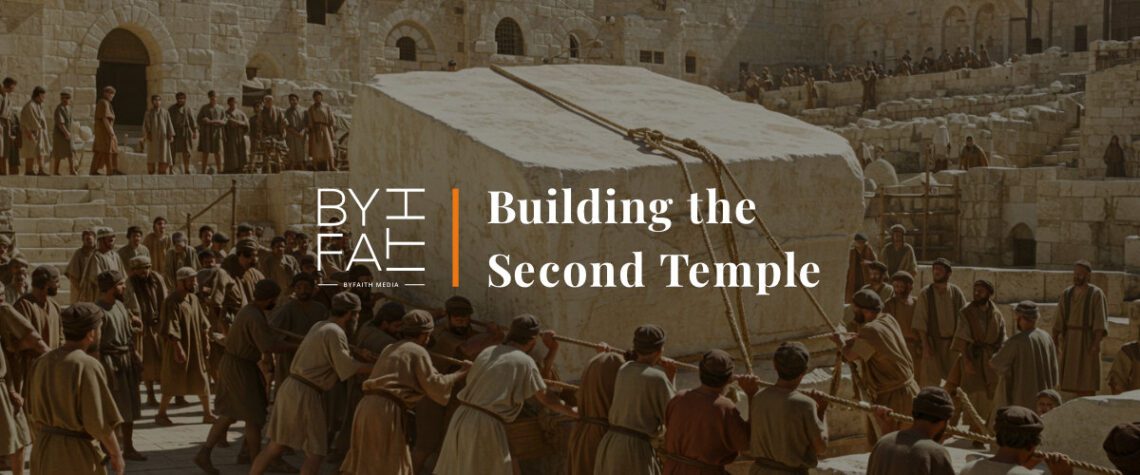
Second Temple Construction in Jerusalem, Materials & Methods Revealed
The Testimony of Josephus
Flavius Josephus, the first-century Jewish historian, provides detailed descriptions of the construction of the Temple in Jerusalem, particularly in his works The Jewish War and Antiquities of the Jews. Regarding the largest foundation stones of the Temple Mount, Josephus does mention their impressive size and the engineering feats involved, though he doesn’t give a step-by-step technical account of how they were laid, but Roman history provides ample evidence to help us understand.
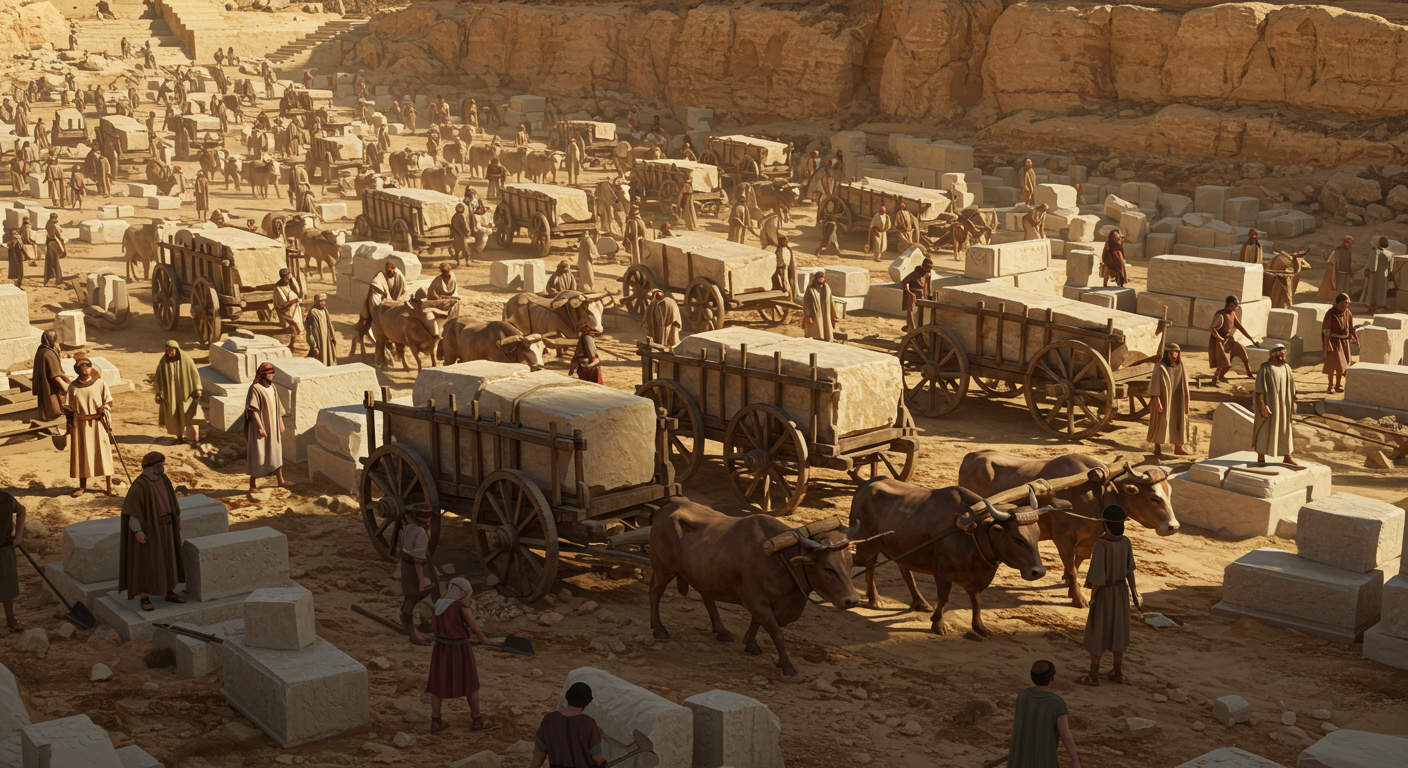
Herod got ready a thousand wagons, that were to bring stones for the building; and chose out ten thousand of the most skilful workmen, and bought a thousand sacerdotal garments, for as many of the priests; and had some of them taught the arts of stone cutters, and others of carpenters; and then began to build: but this not till every thing was well prepared for the work
– Antiquities of the Jews, Book 15, Chapter 11
Walk the Bible, Episode 3
Evidence for the Second Temple

A Roman Book on Architecture
The Romans were masters at scaling up architecture, from aqueducts to temples, to Herod’s projects in Judea, and their methods were a mix of practical ingenuity, advanced tools and sheer manpower. We can learn how they built the Temple Mount drawing on archaeological evidence, texts like Vitruvius’ De Architectura and by studying their physical remains.
In The Jewish War (Book 5, Chapter 5), Josephus describes the massive stones used in the construction of the Temple Mount’s retaining walls, noting that some were as large as 40 cubits (approximately 60 feet or 18 meters) in length. He marvels at their scale, saying they were ‘so exactly united’ that the structure appeared seamless, a testament to the skill of the builders under King Herod’s reign.
In Antiquities of the Jews, he elaborates further, stating that these stones were cut from white marble or limestone, quarried locally, and confirms again they were so precisely fitted that no mortar was needed and we can see this in the Temple tunnels today. Josephus implies significant labour and ingenuity, and he mentions that the stones were transported and positioned with great effort.
Quarrying and Material Prep
Romans sourced stone, usually limestone, marble or basalt, from local quarries to cut transport costs. For big structures, they’d pick sites near usable rock, like Jerusalem’s proximity to limestone beds for the Temple Mount. Workers used iron picks, chisels and wedges to extract blocks. They’d carve channels around a block, hammer in dry wooden wedges, then soak them with water; the swelling wood split the stone cleanly along natural seams.
Tool marks on quarry walls, like those at Mons Claudianus in Egypt or Jerusalem’s Zedekiah’s Cave, show this process. Blocks were roughly shaped on-site to lighten them and exact measurements for the Temple Mount’s largest stone (13.6m x 4.6m x 3.3m, 570 tons) suggest pre-cutting to fit a grand design.

Transport
Moving these giants was a logistical feat. For short distances, Romans rolled stones on logs or stone cylinders, lubricated with water or oil to reduce friction – evidence of worn rollers survives at sites like Ostia. Sledges pulled by oxen or human teams worked too; reliefs from Trajan’s Column show oxen hauling timber, hinting at similar stone transport. Longer hauls used carts with reinforced axles, though anything over 100 tons likely stayed ground-based due to wheel limits.
For the Temple Mount, stones moved less than a kilometre, so rollers or sledges fit the bill. Obelisk transport in Rome, like the 327-ton Vatican obelisk, used ropes, capstans and dozens of teams, suggesting Romans could scale up for Herod’s 570-ton blocks with enough labour.
Lifting and Placement
The Roman polyspastos was a treadwheel crane, powered by men walking inside wheels to turn a winch. Vitruvius (De Architectura, Book 10) describes these lifting 6–10 tons with pulleys amplifying force. Bigger versions, with multiple wheels and counterweights, might’ve handled 50–100 tons; think the 60-ton architraves at Baalbek’s Jupiter Temple. For 570 tons, though, cranes likely played a finishing role, not the main lift; no single crane could manage that. Which is why controversy follows the construction of such temples.
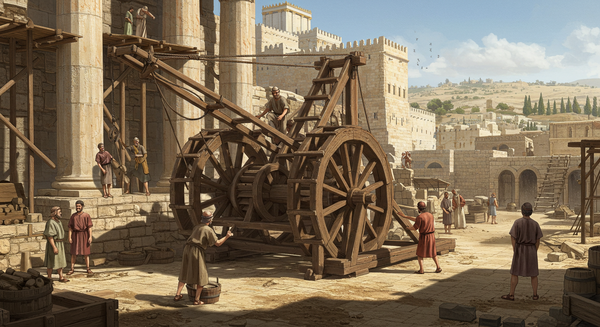
For vertical work, the Romans relied on ramps. Temporary earthen or wooden ramps sloped up to the structure’s height. The Great Pyramid’s ramp remnants inspired this idea and Roman examples, like those theorised at Lisbon’s Aqueduto das Águas Livres, support it. For the Temple Mount’s 30-meter-high walls, ramps could’ve staged stones near their spots, then dismantled post-construction.
Levers and Winches were also used. Long iron-tipped levers, braced against fulcrums, nudged stones into place. Capstans, horizontal winches turned by teams, pulled ropes to drag or tilt blocks. The Temple Mount’s tight stone fits (no mortar, as Josephus explains) suggest levers for final adjustments, with masons grinding edges smooth in situ. Wooden scaffolds would have supported workers and smaller hoists. Rope systems with pulleys, tied to scaffold frames, lifted lighter components or tools, as seen in Colosseum construction debris.
Precision and Assembly
Romans obsessed over fit. Stones were dressed with anathyrosis, edges cut flat, centres slightly hollowed, so weight locked them together without mortar. The Pantheon’s dome and the Temple Mount’s walls both show this. Surveyors used the groma (a cross-shaped tool) for alignment and the chorobates (a water-level device) to check grades, ensuring level foundations even on uneven bedrock, like the Temple Mount’s sloping site. Iron dowels and clamps, poured with lead, linked stones in some projects (e.g., aqueducts), though the Temple Mount’s lowest courses skip this, relying on weight alone.
Manpower and Organisation
Scale demanded labour and slaves. Herod, backed by Rome, had thousands of slaves, soldiers and Jewish workers, as Josephus declares (Antiquities 15.11). Roman legions often doubled as builders; the Pont du Gard aqueduct credits military engineers. A hierarchy of architects, foremen, and labourers coordinated via plans scratched on wax tablets or stone (some survive from Pompeii). For a 570-ton stone, hundreds might’ve pulled ropes, dozens worked levers and specialists oversaw alignment – all fuelled by Roman logistics.
Case Studies
Baalbek’s Trilithon needed three 800-ton stones in the Jupiter Temple’s base, moved from a quarry 800 meters away, likely via rollers and ramps. Minimal lifting (they sit near ground level) contrasts with the Temple Mount’s height, but techniques overlap.
The Pantheon’s 4.5-meter-thick concrete dome used lighter volcanic pumice at the top, showing material smarts. Stonework below relied on cranes and scaffolding.
Aqueducts: Lisbon’s Águas Livres spans valleys with 35-meter arches, built with ramps and winches for 50-ton blocks—smaller but structurally akin to Herod’s walls.
Roman Methods Had Constraints
The evidence that remains is helpful, but there are still some mysteries. Cranes topped out below 100 tons; anything bigger needed ramps or staged lifts, risking collapse if miscalculated. No texts detail 500-ton-plus lifts, Josephus marvels but doesn’t explain, so theories blend evidence with educated guesses or wild speculation – aliens. Weather, terrain and labour unrest (Herod faced Jewish resistance) added hurdles, yet they pulled it off.
Romans therefore built huge stone structures with a toolkit of ramps, cranes, levers, and precision surveying, backed by massive labour and local stone. For the Temple Mount, picture ramps hauling 570-ton blocks up, levers tweaking them into place, and masons perfecting the fit, all under Roman know-how adapted to Herod’s vision. But the mystery of how the largest stones were moved remains.
- Biblical Archaeology
- Walk the Bible
- Christianity and Culture
- Christianity and Art
- Christian Book Reviews
- Recent Articles
By Paul Backholer. Find out about Paul’s books here.
Don’t forget to Subscribe to Walk the Bible on YouTube & follow us on social media @walkthebible to keep up-to-date with the latest episodes from ByFaith TV.