Beyond the Council of Jerusalem, The Unresolved Crisis of the Gentile Jewish Church, Paul in Athens
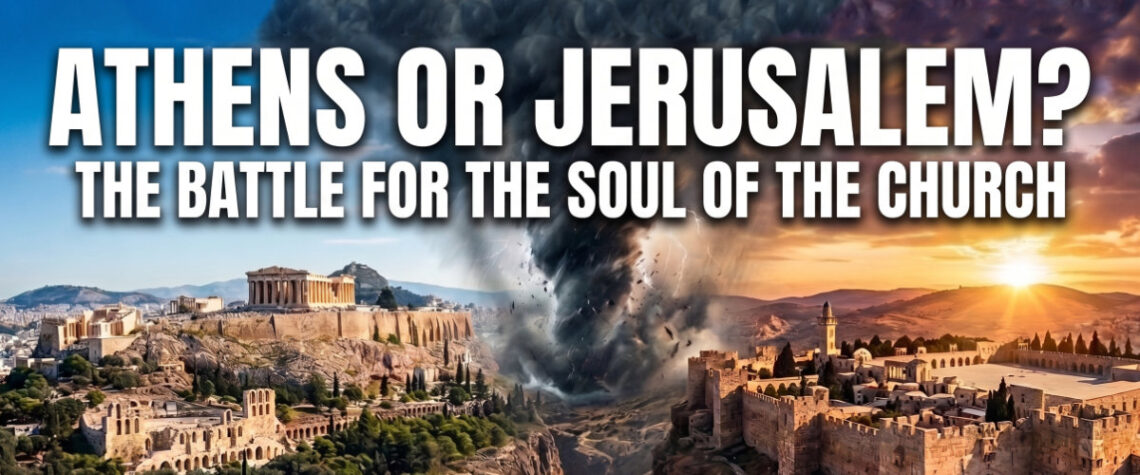
“What has Athens to do with Jerusalem?” This famous question, posed by the early Church Father Tertullian, captures the ultimate identity crisis of the early Church.
In this episode, we travel to Athens, the intellectual capital of the ancient world, where the Apostle Paul stepped directly into a philosophical crossfire. While Paul masterfully used Greek ideas to speak to the Gentiles on the Areopagus, he was soon fighting a desperate battle to keep this burgeoning global movement tethered to its spiritual home of Jerusalem.
Athens or Jerusalem? Paul in Athens, the Gentile-Jewish Debate, EP 18
Then certain Epicurean and Stoic philosophers encountered him. And some said, “What does this babbler want to say?” Others said, “He seems to be a proclaimer of foreign gods,” because he preached to them Jesus and the resurrection. And they took him and brought him to the Areopagus, saying, “May we know what this new doctrine is of which you speak?”
– Acts 17:18-19
Paul was winning many to the Lord, but how could the Church welcome the Greek world without losing its Hebrew soul? Join us as we explore how Paul fiercely protected the spiritual heritage of Israel, preaching a Gospel rooted not in human philosophy, but in the Divine fulfilment of biblical prophecy, revealing Jesus Christ not as a Greek ideal, but as the promised Root and the Offspring of David.
Gentiles in a Jewish Religion
The Jerusalem Council (Acts 15:1-30) settled the question of whether Gentile converts needed to follow Mosaic law, but it inadvertently sparked an identity crisis that threatened to tear the early Church apart. As the faith moved out of Judea and into the Greco-Roman world, a profound question emerged:
Would Christianity remain rooted in the Divine revelation given to Israel and the Jews in Scripture, or would it surrender its identity to the human philosophy of Athens?
When the Apostle Paul arrived in Athens, he stepped into the intellectual nerve centre of the ancient world. Standing before Epicurean and Stoic philosophers at the Areopagus, Paul faced the ultimate challenge of spiritual contextualisation. He needed to speak their language without compromising the Gospel’s Jewish foundation and prepare his converts to understand biblical prophecies about the restoration of Israel.

The Philosophical Crossfire in Athens
Paul’s strategy in Athens was masterful. Instead of quoting Hebrew Scripture to an audience that did not recognise its authority, he engaged them on their own terms. He pointed to their altar dedicated “To an Unknown God” and even quoted Greek poets like Aratus to bridge the cultural chasm:
Then Paul stood in the midst of the Areopagus and said, “Men of Athens, I perceive that in all things you are very religious; for as I walked around and looked carefully at your objects of worship, I even found an altar with this inscription: to an unknown god. So you are ignorant of the very thing you worship—and this is what I am going to proclaim to you”
– Acts 17:23
By using Greek concepts, Paul demonstrated that the God of Israel was the Creator of all humanity. However, Paul was not trading Jerusalem’s revelation for Athenian philosophy. The moment he preached the physical resurrection of Jesus, the philosophers mocked him. For the Greeks, the material world was inferior to the spiritual; the idea of a resurrected body was foolishness. Paul’s refusal to dilute this core Jewish-apocalyptic truth proved that his loyalty remained firmly with Jerusalem.
- Why Scientists Think God Could Exist
- Abolishing Childhood, The Age of Innocence
- Is Being Woke Christian or Antichrist?
- Homosexuality and the Collapse of Society
- What Has Gone Wrong with the West?
- What is a Woman? And why it Matters
- Stock Market Crash – The Everything Bubble
- Electric Vehicles are not Eco-Friendly
- Climate Activists and Tantrums
- Climate Change Hypocrisy!
- Reparations Have Been Paid For Slavery
- How Civilisations Collapse, the West
- Jordan Peterson and the Quest for a Mentor
- Why Believing in God Makes Sense
- Can Boys Become Girls? Gender Dysphoria
- Borders are Good! The Bible, Immigration
- The Forgotten White Slaves of History
- Cancel Culture and Faith: Is Woke Broke?
- The Collapse of the United States
- Make 1984 Fiction Again: George Orwell, 666
- Why is the Church in Decline in Britain?
- BBC Bias and its Christian Foundation
- Christianity and Art
- Christianity and Culture
- Christian Book Reviews
- Can we Trust Scientists
The Fight for Christian Identity
As the Gentile Church outgrew its Jewish founders, the fierce debate among New Testament writers was never about abandoning Christianity’s Jewish origins, but about how to defend them while welcoming a Gentile world. Paul fiercely resisted the idea that the Church should become a purely philosophical school. He warned the Colossians against the very trap many accused him of falling into:
See to it that no one takes you captive through hollow and deceptive philosophy, which depends on human tradition and the elemental spiritual forces of this world rather than on Christ
– Colossians 2:8
For Paul, Hebrew prophecy was non-negotiable. He spent much of his ministry, particularly in his letter to the Romans, fighting to ensure that the influx of Gentile believers did not lead to the erasure of Israel’s future in God’s redemptive plan. He reminded Gentile converts that they did not replace Israel; rather, they were merely wild olive shoots grafted into a deeply Jewish root:
If some of the branches have been broken off, and you, though a wild olive shoot, have been grafted in among the others and now share in the nourishing sap from the olive root, do not consider yourself to be superior to those other branches
– Romans 11:17-18
Jerusalem’s Victory Over Athens
Although the landmark Council of Jerusalem firmly resolved that Gentile followers of Jesus were not required to convert to Judaism or follow the Mosaic law, it left a massive, unresolved theological vacuum: how these new Gentile believers should understand their relationship to the future restoration of Israel.
For Paul, the inclusion of the Gentile nations did not rewrite the timeline of Israel; he fiercely maintained that the Old Testament prophecies concerning Jewish redemption remained entirely valid, literal and active
By freeing Gentiles from the law, the Council of Jerusalem did not settle how they were to interpret the explicit Old Testament prophecies concerning the literal, physical restoration and redemption of the Jewish nation, its eventual recognition of Jesus as the true King of Israel, and the ultimate return of Jesus to a distinctly Jewish Jerusalem that finally accepts Him. Consequently, as the Church rapidly expanded into the Greek and Roman worlds, early leaders like Paul faced the monumental task of ensuring that Gentile Christians did not use their freedom to disconnect from Israel’s prophetic timeline or allegorise away the concrete promises made to the Jewish people.
To the Jews I became as a Jew, that I might win Jews; to those who are under the law, as under the law, that I might win those who are under the law; to those who are without law, as without law (not being without law toward God, but under law toward Christ), that I might win those who are without law; to the weak I became as weak, that I might win the weak. I have become all things to all men, that I might by all means save some. Now this I do for the gospel’s sake, that I may be partaker of it with you.
– 1 Corinthians 9:20–23
By Paul Backholer. Find out about Paul’s books here.