
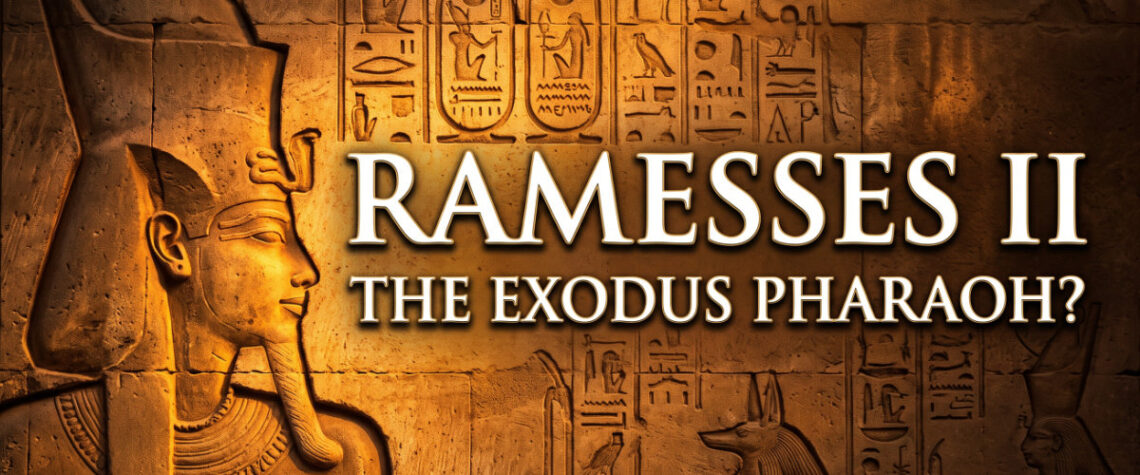
Is Ramesses II the Exodus Pharaoh?
For centuries, popular imagination has cast one man as the hard-hearted ruler who defied Moses: Ramesses II, the longest-reigning and most self-promoting pharaoh in Egyptian history. Hollywood loves him. Documentaries love him. Yet the evidence—biblical, chronological and archaeological—quietly but firmly shows he is the wrong man; let’s discover why.
So Joseph settled his father and his brothers in Egypt and gave them property in the best part of the land, the district of Rameses
– Genesis 47:11
Is Ramesses II the Exodus Pharaoh? EP 17
The Name Ramesses in Scripture
Start with the name itself. In Genesis, long before the Exodus, we read that Joseph settled his family in ‘the land of Rameses’ (Genesis 47:11). The name was already in use in the patriarchal period. It does not identify the later oppressor of the Hebrews any more than the modern name ‘Alexandria’ identifies Julius Caesar. The biblical writers simply used a familiar regional designation that later became famous under the 19th Dynasty. Treating the appearance of ‘Rameses’ as proof that Ramesses II was the Exodus pharaoh is circular reasoning dressed up as scholarship.
Then comes the calendar. The Bible itself supplies a clear chronological marker.
First Kings 6:1 states that Solomon began building the Jerusalem Temple in the fourth year of his reign, 480 years after the Israelites came out of Egypt. Working from the widely accepted date for Solomon’s accession, that calculation places the Exodus in 1446 BC. Ramesses II, by contrast, ruled from roughly 1279 to 1213 BC—nearly two centuries later.
Two hundred years is not a rounding error. It is the difference between the height of the 18th Dynasty and the glory days of the 19th. If the biblical timeline is taken seriously as it should, Ramesses II was not even a distant ancestor of the pharaoh who faced Moses; he lived in an entirely different era.

Abu Simbel
In this episode, Paul and Mathew make the journey many Exodus scholars dreams of. They stood before the rock-cut temples of Abu Simbel, gazed up at the four seated giants of Ramesses, and walked the processional avenues of Karnak looking for any tangible link between this pharaoh and the Hebrew people. They found none. No inscriptions mentioning Israelite slaves under his rule. No sudden depopulation of the Nile Delta matching the biblical departure. No record of a catastrophic series of plagues or the drowning of an army in the sea. The biblical account is not at fault; the mistake is treating Ramesses II as the Exodus pharaoh.
Ramesses filled Egypt with monuments proclaiming his victories and piety; the silence regarding the events of Exodus is conspicuous. The stones that shout his name so loudly are mute on the subject that would have been the greatest humiliation of his reign—if it had happened on his watch.
The Bible, meanwhile, points elsewhere. The early-date framework of 1446 BC places the Exodus squarely in the 18th Dynasty, during the powerful reigns of Thutmose III and his successor Amenhotep II. These were the pharaohs of Egypt’s imperial zenith, men who campaigned deep into Canaan and Syria, exacted heavy tribute, and maintained the kind of centralised control that could both oppress a large foreign population and then lose it in a single dramatic night.
The biblical description of a pharaoh whose heart is hardened, whose firstborn dies, and whose chariot force is destroyed fits the profile of that earlier age far better than the later, more introspective, and propaganda-saturated world of Ramesses II.
- Why Scientists Think God Could Exist
- Abolishing Childhood, The Age of Innocence
- Is Being Woke Christian or Antichrist?
- Homosexuality and the Collapse of Society
- What Has Gone Wrong with the West?
- What is a Woman? And why it Matters
- Stock Market Crash – The Everything Bubble
- Electric Vehicles are not Eco-Friendly
- Climate Activists and Tantrums
- Climate Change Hypocrisy!
- Reparations Have Been Paid For Slavery
- How Civilisations Collapse, the West
- Jordan Peterson and the Quest for a Mentor
- Why Believing in God Makes Sense
- Can Boys Become Girls? Gender Dysphoria
- Borders are Good! The Bible, Immigration
- The Forgotten White Slaves of History
- Cancel Culture and Faith: Is Woke Broke?
- The Collapse of the United States
- Make 1984 Fiction Again: George Orwell, 666
- Why is the Church in Decline in Britain?
- BBC Bias and its Christian Foundation
- Christianity and Art
- Christianity and Culture
- Christian Book Reviews
- Can we Trust Scientists
Historical and Scholarly Critique
None of this diminishes Ramesses as biblical important. He remains one of history’s most remarkable rulers—warrior, builder, diplomat and survivor of an astonishingly long reign. His temples still take the breath away. But greatness is not the same as chronological fit.
The popular identification of Ramesses II with the Exodus is a modern romance born of the grandeur of his monuments and the familiarity of his name. The ancient text, the arithmetic of the kings and the silence of the archaeological record all tell a different story. The pharaoh of the Exodus lived two hundred years earlier, in a different dynasty, under a different sky. Ramesses the Great simply arrived too late for the part.
The Israelites set out from Rameses on the fifteenth day of the first month, the day after the Passover. They marched out defiantly in full view of all the Egyptians
– Numbers 33:3
By Paul Backholer. Find out about Paul’s books here.