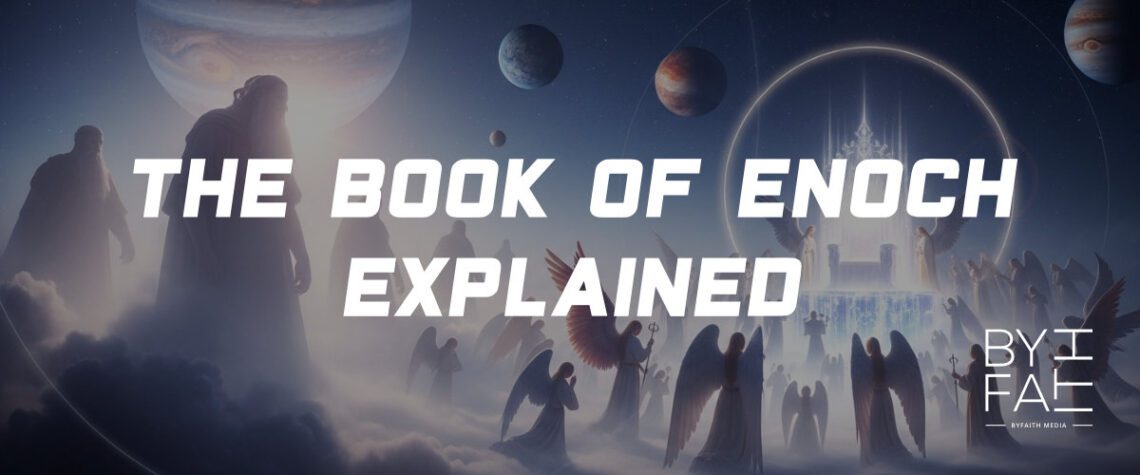
The Book of Enoch Explained: The Forbidden Scrolls that Terrified and Confused Ancient Priests
What the Book of Enoch Says About Angels, Giants and the End of the World
Imagine unearthing a 2,300-year-old manuscript that claims angels crashed to earth, bred monstrous giants and taught humanity the arts of war and witchcraft, then were chained in a cosmic dungeon until Judgement Day. Sound like fantasy? It’s not. It’s the Book of Enoch and it was banned from the Bible.
The Book of Enoch is one title with five books under its cover.
- The Book of the Watchers (ch. 1–36)
Angels crash-land, breed giants, get chained. - The Book of Parables (ch. 37–71)
The Son of Man sits on the throne of glory. - The Astronomical Book (ch. 72–82)
Uriel gives Enoch a 364-day cosmic calendar. - The Book of Dreams (ch. 83–90)
History told as sheep, wolves and one white bull. - The Epistle of Enoch (ch. 91–108)
Last-will-and-testament to his children.
The Enoch Verses that Shook Judaism
Just six cryptic lines in the Bible’s Book of Genesis 6:2 read: “And it came to pass… that the sons of God saw the daughters of men that they were fair; and they took them wives…” In the 2nd century BC, an anonymous Jewish visionary decided that wasn’t enough. He wrote an explosive 108-chapter sequel, 1 Enoch and it spread like wildfire through the ancient world. But nobody wanted to read a book by an unknown scribe, so the author had a great idea and ascribed it to Enoch. The Essenes read it, Jews debated it and early Christians read it and doubted. The Epistle of Jude quotes it directly and yet, by the 4th century AD, church leaders, following Jewish scholars buried it. So what’s inside that scared the sandals off the ancient priests?
The Rebel Angels who Started a Cosmic War
Picture this: 200 celestial beings, the Watchers, stationed in heaven’s observation deck. Their leader? Semyaza. Their crime? Lust. They descend to Mount Hermon in Israel around 3,000 BC, seduce human women, and sire a race of Nephilim, towering, bloodthirsty giants who devour crops, livestock and eventually people.
The giants turned against them and devoured mankind… they began to sin against birds, beasts, reptiles, and fish
– 1 Enoch 7:3–5
But it gets darker. These angels didn’t just breed, they taught forbidden tech: Azazel showed how to forge swords and shields; Shemhazai taught sorcery and root-cutting; Baraqiel revealed astrology; Kokabiel shared constellation secrets. Result? Earth becomes a dystopian warzone. Humanity cries out and God sends Enoch, Noah’s great-grandfather, as a divine whistleblower.
Enoch’s Terrifying Tour of the Afterlife
I saw the winds which turn the sky… and the foundations of the earth
– 1 Enoch 18:10
The book claims God pulls Enoch into the sky for a VIP tour of the cosmos. What he sees is mind-bending: a prison of stars where fallen angels are bound in chains of fire; four hollows in a mountain, one for righteous souls (paradise), one for sinners (torment), and two more… still empty, waiting for the final judgement; a river of fire flowing into a crystal sea. This isn’t poetry. It’s ancient astronaut theory that early Christians were familiar with.
Enoch, the seventh from Adam, prophesied about them: “See, the Lord is coming with thousands upon thousands of his holy ones to judge everyone, and to convict all of them of all the ungodly acts they have committed in their ungodliness, and of all the defiant words ungodly sinners have spoken against him.”
– Holy Bible, Book of Jude 14-15
Jesus of Nazareth, the Son of Man
Fast-forward to the Parables section. Enoch sees a throne of glory and a figure called the Son of Man, a foreshadowing of Christ as Messiah who judges kings and angels, sits on God’s throne and triggers the resurrection of the dead. Sound familiar?
With him was another whose face had the appearance of a man… and this is the Son of Man who has righteousness, with whom righteousness dwells… He will be a staff to the righteous… all the secrets of wisdom will flow from his mouth
– 1 Enoch 46:1–3; 48:2–6
Enoch’s jaw drops. The angel explains this Son of Man existed before the sun and stars. He will sit on God’s own throne. He will judge every king and angel at the end of days. Then comes the Apocalypse of Weeks: history as a 10-stage countdown. “In the 10th week… the great judgement will be executed” (1 Enoch 91:15).
The Book of Enoch shows Jews were already looking for the a Divine-human figure to be sent from God, which is one reason so many Jews followed Jesus when He started preaching. The Holy Bible had already foretold the coming of the Son of Man (Exodus 24:10, Daniel 7:9, Ezekiel 1:26), and when Jesus appears after His resurrection we are told, ’Beginning at Moses and all the prophets, He expounded unto them in all the Scriptures the things concerning Himself’ (Luke 24:27).
Jesus said, “You also must be ready, because the Son of Man will come at an hour when you do not expect Him”
– The Holy Bible, Luke 12:40
The Animal Apocalypse That Predicted History
In a dream, Enoch sees world history as a zoo: sheep = Israelites; wolves = Egypt; wild boars = Greece; eagles = Rome. The climax? A white bull with huge horns, a new Messiah, transforms the animals into humans and it eerily predicts empires rising and falling, just as Daniel does in the Holy Bible.
The 364-Day Calendar that Defied Babylon
Then comes the Astronomical Book of Enoch, a long confusing revelation on the stars and solar system. But when interpreted it shows the Angel Uriel revealing the sun’s chariot and the moon’s gates as vehicles for the solar calendar of 364 days, perfectly divisible by 7. This was a rebellion against Babylon’s lunar calendar. Jewish sects used it until Rome crushed them.
The Final Twist
Enoch walked with God; then he was no more, because God took him
-The Holy Bible, Genesis 5:24
In the Bible, Enoch never died and the Book of Enoch claims he was transformed into the angel Metatron, scribe of heaven. But Jesus didn’t teach that humans who trust in Him will become angels after they die, but rather they will be like the angels (Mark 12:25). A distinction that is important.
Jesus’ Little Brother Quotes Enoch
Meet Jude: the sibling who grew up in the same modest Nazareth workshop, experienced the same splinters and questioned Jesus as the beginning of HIs ministry (John 7:5). Mark 6:3 lists him: “James, Joses, Judas, Simon… aren’t these the carpenter’s sons?” That Judas is our Jude, the author of the New Testament book Jude, the Greek shortening of Judah.
Two of Jesus’ brothers traded the carpenter’s apron for the dusty sandals of discipleship. James, the eldest, met the risen Christ in a private encounter that transformed him from family sceptic to Jerusalem’s bishop; within twenty years he was chairing the first church council and penning the epistle that still explains to Christians the difference between faith and works.
Jude, the baby brother, followed suit, convinced by Jesus’ resurrection that He was the Son of God and by the mid-60s AD, Jude is a pillar of the Jerusalem church, signing his letter simply “Jude, servant of Jesus Christ, brother of James.” In twenty-five blistering verses he torches travelling con-artists who’ve wormed into house-churches, twisting grace into a licence for orgies. To hammer the point home he reaches for unlikely artillery in the Jewish underground: the Book of Enoch. Verses 14–15 detonate straight from Enoch 1:9: “Behold, the Lord comes with ten thousands of his holy ones to execute judgement on all…”
Early Christians gasped; later bishops broke into a cold sweat. Here’s the bit that still sparks arguments in theology colleges: one quote does not equal a canon badge. Jude treats Enoch the way Paul treats a pagan poet in Acts 17, snatch a diamond of truth, leave the rest of the quarry. The diamond? God really did jail rebel angels and will judge false teachers. The quarry? 108 chapters of cosmic tourism, giant gore and star-chariots. Jude wants the warning, not the whole fan-fiction.
Think of your pastor bellowing a Darth Vader quote; nobody rushes to slot the script of the film between Romans and Revelation. Same principle. Jude loved Jesus, loathed liars and weaponised one quote from a banned book for a single, glorious mic-drop. He distinguished between the inspired verse and the fake.
- Borders are Good!
- Bible Verses About Borders
- Abolishing Childhood, The Age of Innocence
- Is Being Woke Christian or Antichrist?
- Homosexuality and the Collapse of Society
- What Has Gone Wrong with the West?
- What is a Woman? And why it Matters
- Stock Market Crash – The Everything Bubble
- Electric Vehicles are not Eco-Friendly
- Climate Activists and Tantrums
- Climate Change Hypocrisy!
- Reparations Have Been Paid For Slavery
- How Civilisations Collapse, the West
- Evidence For Jesus’ Resurrection
- Archaeological Evidence for Joseph
- 3rd Temple of Jerusalem New Documentary
- Can Boys Become Girls? Gender Dysphoria
- The Forgotten White Slaves of History
- Cancel Culture and Faith: Is Woke Broke?
- The Collapse of the United States
- Make 1984 Fiction Again: George Orwell, 666
- Why is the Church in Decline in Britain?
- BBC Bias and its Christian Foundation
- The Spirit of Depression Defeated
- The Death of New Atheism
- Dostoevsky’s The Grand Inquisitor
- Albert Einstein’s Faith
- Christianity and Art
- Christianity and Culture
- Christian Book Reviews
Barred from Scripture for a Reason
Ancient Jewish sages had already smelled trouble centuries earlier; the historical Enoch vanished c. 3039 BC, but the scrolls surface c. 200 BC in Israel and the style was inconsistent with ancient writings. Enoch sprouted contradictory statements, rival lists of archangels and wild tales of heavenly encounters that refused to square with the Torah’s chronicle. Rather than patch the cracks, rabbis shelved the scroll, leaving it to thrill forbidden-books clubs while the synagogue stuck to Moses.
Out in the wilderness beside the Dead Sea, the Essenes kept studying and copying the book, and later the Ethiopian Orthodox Church kept it in their scriptorium. One quotation in the New Testament kept the ember glowing, but for the official canon the verdict was unanimous: brilliant, uninspired and mostly fake, more brilliant Second-Temple theological fiction than Scripture.
Surprisingly, by the 2nd century AD, the fiery North-African scholar Tertullian was waving the Book of Enoch like a battle standard, insisting its angel-jails and star-prisons proved it belonged in Scripture. A hundred years later, the Council of Laodicea quietly struck it from every church lectern and by AD 400 the towering bishop Augustine delivered the polite coup de grâce: lovely cosmic fireworks, but no divine authorship. At a two-hour read, the reader must bear in mind the Book of Enoch is not inspired or biblical.
Enoch… these writings have no place in that canon which was preserved in the temple… for their antiquity brought them under suspicion… the writings which are produced under his name and which contain these fables about the giants saying that their fathers were not men, are properly judged by prudent men to be not genuine
– The City of God (Book XV, chapter 23), Augustine
By Paul Backholer. Find out about Paul’s books here.