
From Lalibela’s Rock-Hewn Churches to the Trail of the Ark of the Covenant & Queen of Sheba
The underground churches of Lalibela are a defiant act of faith carved straight out of the living rock. Between the 12th and 13th centuries, King Lalibela, guided, legend says, by angels in his dreams – ordered eleven monolithic churches to be hewn downwards into the red volcanic tuff of the Lasta Mountains. The result is a subterranean African Jerusalem, for Ethiopian Orthodox Christians, who could no longer safely make pilgrimage to the Holy Land after Saladin’s conquests and who needed a safe place from the Islamic armies seeking to spread Islam by force.
Walk the Bible, Episode 13
Underground Rock Churches, the Ark & Queen of Sheba, EP 13
Don’t forget to Subscribe to Walk the Bible on YouTube & follow us on social media @walkthebible to keep up-to-date with the latest episodes from Walk the Bible.
We arrived at this underground labyrinth to witness priests at prayer in their shimmering robes, chanting inside the exquisite cruciform church of St George, its roof level with the surrounding courtyard and its walls plunging three storeys into the earth. To reach the churches, one descends through trenches and tunnels, sometimes on hands and knees, emerging blinking into sunken courtyards where barefoot pilgrims prostrate themselves on the rough stone.
We spent the day wandering these sacred underground mazes, slipping through dark connecting passages where the only light came from narrow skylike openings far overhead, brushing past worn rock frescoes of saints whose eyes seemed to follow us. In Bet Maryam, the Church of the Virgin Mary, we watched a priest unwrap layer after layer of embroidered cloth to reveal a 13th-century gold processional cross. But Lalibela is only the beginning of a far older legend.
Every Orthodox Ethiopian will tell you with absolute certainty that the Ark of the Covenant rests not in Jerusalem, but in Axum, hidden within the modest Chapel of the Tablet beside the Cathedral of St Mary of Zion. The claim originates in the Kebra Nagast, Ethiopia’s national epic, which recounts a myth of how Menelik I, son of King Solomon and the Queen of Sheba, brought the Ark to Ethiopia in the 10th century BC for safekeeping.
When the Queen of Sheba heard of Solomon’s fame, she came to Jerusalem to test him with hard questions…Solomon answered all her questions; nothing was too hard for him to explain to her… she was overwhelmed
– 2 Chronicles 9:1-4
Axum, ancient capital of the Axumite Empire (c.100–940 AD), greeted us with the silence of ruins that once commanded trade routes from Rome to India. The first sight that stops the breath is the Northern Stelae Field, a forest of towering granite obelisks carved to represent multi-storey buildings. The greatest of them, the fallen Great Stele, lies shattered where it collapsed during erection nearly 1,700 years ago; it would have stood 33 metres high.

Across the road is the modest stone building that supposedly guards the Ark itself. Only one man, the Guardian of the Ark, appointed for life and never allowed to leave the chapel grounds, is permitted to see it. Photography is forbidden; even speaking too loudly feels sacrilegious. Whether the wooden box inside is the genuine Ethiopian Ark or a later replica is unknown; what is true is that there is an unbroken chain of belief that has protected it for millennia.
Deeper into the royal necropolis, we explored the Tombs of Kings Kaleb and Gebre Meskel, vast underground chambers lined with precisely cut granite blocks. Torchlight revealed dovetail joints so tight you cannot slip a blade between them, archways and false doors that echo pre-Christian Axumite architecture. In one side chamber lies a sarcophagus still bearing traces of its original red paint; in another, a row of what appeared to be sacrificial altars.
But the greater revelation came along a dusty track south of Axum to Dungur, known to the locals as the Palace of the Queen of Sheba. The ruins sprawl across a low hill, massive walls of finely fitted stone blocks without mortar, doorways with the characteristic Axumite monkey-head brackets, and a grand staircase that once descended to a paved courtyard.
Excavations have revealed a complex of over fifty rooms, bathrooms with sophisticated drainage, and what may have been a throne dais (raised platform). Scholars argue over the dating; some insist the palace belongs to the 6th–7th century AD, long after the historical Queen of Sheba would have lived. But the German archaeologist we spoke to told us he found a layer dating back to the time of Solomon. However, standing among those cyclopean walls as the sun bled across the plains of Adwa, it was impossible not to imagine the Queen of Sheba herself, the queen who Scripture says travelled to Jerusalem laden with gold and spices. Ethiopia may add its own legends, but their faith in Jesus Christ remains strong.
So he started out and on his way he met an Ethiopian eunuch, an important official in charge of all the treasury of the Kandake (which means ‘queen of the Ethiopians’)… They came to some water and the eunuch said, “Look, here is water. What can stand in the way of my being baptised?” And he gave orders to stop the chariot. Then both Philip and the eunuch went down into the water and Philip baptised him
– Acts 8:26, 36-38
From the rock-hewn sanctuaries of Lalibela to the stelae of Axum and the whispered presence of the Ark, the past here is not buried; it watches from the shadows. We left at dusk, the obelisks silhouetted against a violet sky, carrying with us the faint echo of Ge’ez chants and the unshakable conviction that some secrets are best left exactly where they are.
- The Book of Revelation Chronology: An End Time Timeline by Paul Backholer
- A Third Temple in Jerusalem will be Built
- The Battle of Armageddon and the Return of Jesus Christ to Israel
- 666 – The Mark of the Beast and the End Times Antichrist
- What is the Rapture?
- Six End Time Signs for Israel
- 20 Signs of the End Times
- Christians will be Raptured before the Tribulation
- The Seven Trumpets in the Book of Revelation
- Borders are Good! The Bible, Immigration, Refugees & Economic Migrants
- Is Being Woke Christian or Antichrist?
- The Collapse of the United States: A Time-Traveller from 1950 Visits the US in 2023
- Homosexuality, Promiscuity and the Collapse of Society: Follow the Science
- The Forgotten White Slaves and the Ignored History of Slavery Worldwide
- What is a Woman? And why it Matters to Christians
- Why Abortion is Wrong
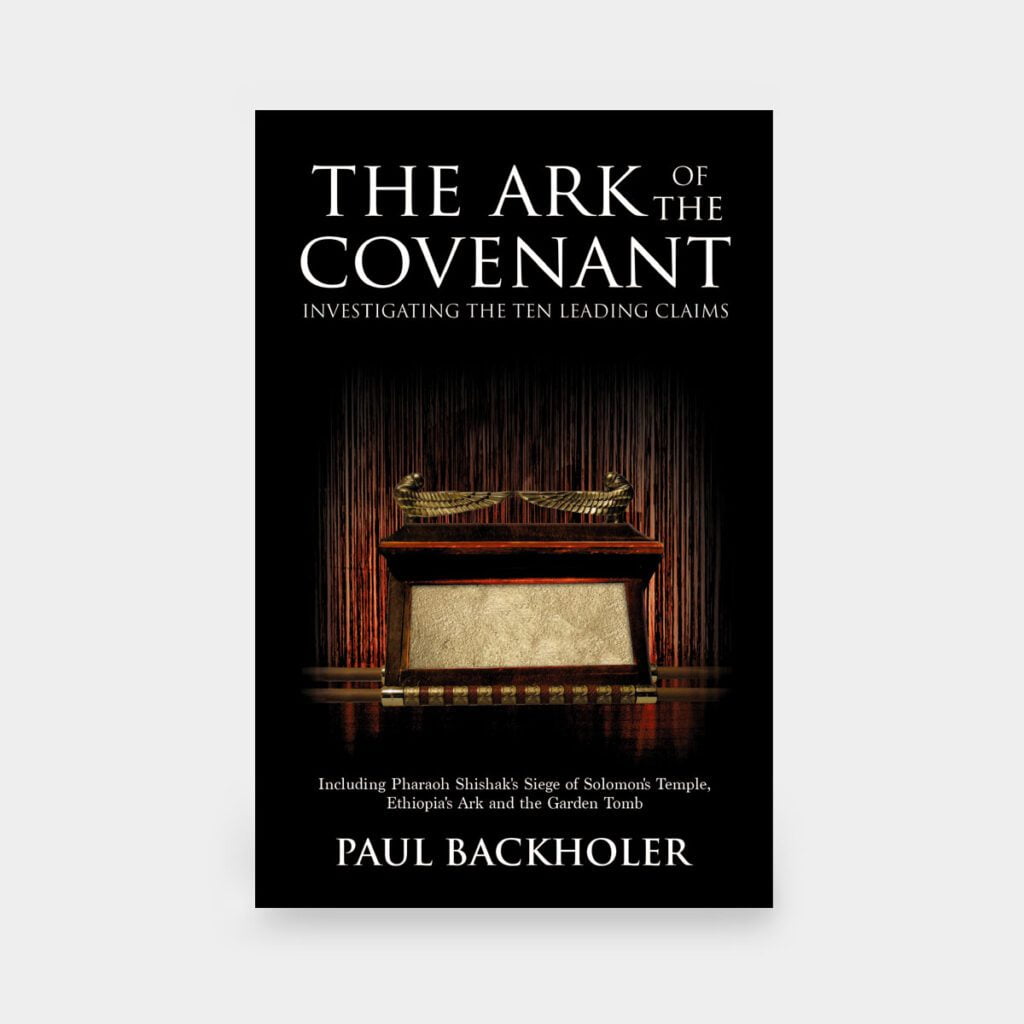
Ethiopia’s Ark: A Beautiful Story That Doesn’t Fit the Biblical Calendar
The Ethiopian claim is one of the most interesting legends in the Christian world, but it collides head-on with the internal chronology of the Bible itself. Scripture never loses sight of the Ark in the timeline suggested by Ethiopians.
From the wilderness tabernacle to Shiloh, from the house of Abinadab to the City of David and finally to Solomon’s newly built Temple, the biblical writers carefully track its journey. The Queen of Sheba visits Jerusalem precisely during the period when, according to 1 Kings 8 and 2 Chronicles 5–7, the Ark is being carried in solemn procession into the Holy of Holies beneath the wings of the cherubim.
At the very moment the Kebra Nagast says Menelik slips away with the Ark, the Bible insists it is sitting in pride of place in the brand-new Temple, surrounded by priests and cloud-like glory. Centuries roll on and the biblical authors still know exactly where the Ark is, and the prophets continue to reference it as a present reality in Judah.
Jeremiah, writing on the eve of the Babylonian exile, warns that one day people will no longer speak of the Ark, yet in the same breath he confirms that in his own day it remains a central symbol of God’s presence in Jerusalem (Jeremiah 3:16–17). That is roughly four hundred years after Solomon’s reign and therefore four hundred years after Menelik’s supposed journey.
The last unambiguous biblical sighting of the Ark comes in 586 BC, when Nebuchadnezzar’s troops burn the Temple. After that, Scripture falls silent; the Ark simply vanishes from the record. But that silence begins 363 years too late for the Ethiopian tradition to be reconciled with the Old Testament timeline.
The Kebra Nagast is not a dry historical treatise; it is a national epic that weaves together Solomon and Sheba, Jewish roots, Christian destiny and Ethiopian belief into a single luminous thread. For more than seven centuries, the guardians in Axum have maintained their solitary vigil and the belief itself has shaped a unique Christian civilisation high in the Horn of Africa.
Archaeology and carbon-dating cannot settle a question that lives in the realm of faith and identity. Yet when measured strictly against the sequence of events laid out in the Hebrew Scriptures, the chronology refuses to align. Ethiopia guards a treasure beyond price, but the biblical Ark never left Jerusalem until the fires of Babylon consumed its house. After that, its fate remains one of Scripture’s great unspoken mysteries.
The Ethiopian tradition is magnificent, moving and deeply cherished. It is many things, but it is not the continuation of the biblical story. It is something else entirely: a parallel sacred history, radiant in its own right, yet running on a different calendar from the one written in the pages of Kings and Chronicles.
By Paul Backholer. Find out about Paul’s books here.
Don’t forget to Subscribe to Walk the Bible on YouTube & follow us on social media @walkthebible to keep up-to-date with the latest episodes from Walk the Bible.