The Korean War, Intercession & Revival
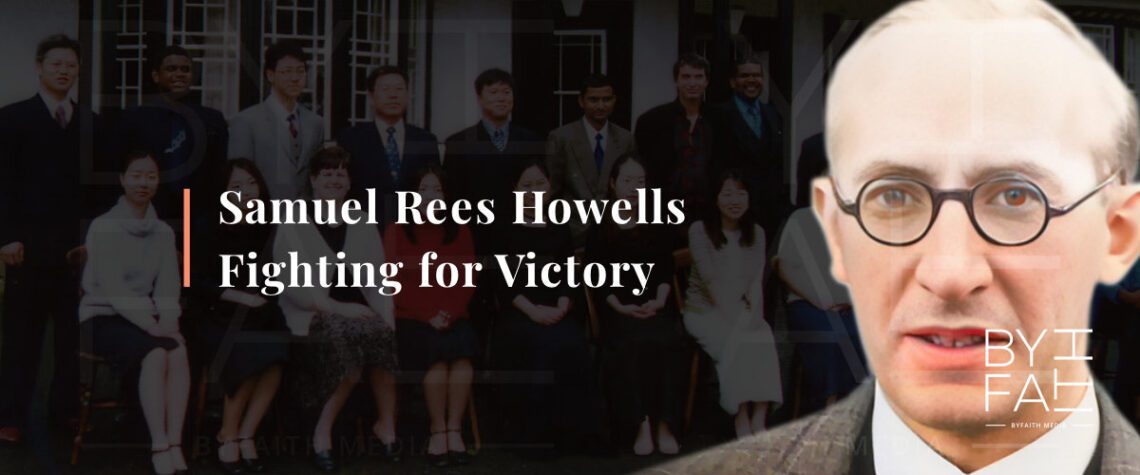
Samuel Rees Howells Fighting for Victory
In the 1950s, Samuel Rees Howells of the Bible College of Wales did not know that the Lord would one day call him to intercede for the demise of Communism worldwide. In his early intercessory battles, the Lord was preparing him, as he was led to gain positions of grace by challenging and binding various principalities and powers during Communist conflicts. It was no secret that the West regarded Communism as a threat to liberty worldwide, but Samuel was not led to pray for the fall of Communist regimes because of Western hostility to this system.
Samuel Rees Howells was never led to pray political prayers. Every intercession that the Holy Spirit laid upon him was always a Kingdom prayer. Whenever a situation or conflict was placed in Samuel’s spirit, his greatest concern was to know the will of the Lord. God’s purposes, as revealed by the Holy Spirit, would always concern the Kingdom of God.
He was never led to pray for his nation’s overseas interests (unless it was by God’s will), because the intercessor cannot have a national, political or denominational bias. They may indeed love their country and vote, but their intercessions can never be influenced by the foreign policy of their nation or the politics they hold. All these must be put to the cross and cannot bear down on the intercession. “There cannot be a cross-current,” Rees had taught his son.
Our Father in Heaven, hallowed be Your name. Your Kingdom come. Your will be done on earth as it is in Heaven
– Luke 11:2
Samuel Rees Howells’ prayer battles to bind the spiritual hosts working through Communism were far-reaching around the world. Nonetheless, whenever progress seemed to be made, the threat from the demonic powers often switched to another theatre of war.
Samuel would spend most of his life interceding for Gospel liberty around the world and just as the Bible College of Wales was focusing on prayer for world evangelisation, a battle began in Korea that threatened the whole of Asia.
At 4am on 25 January 1950, the army of the Communists of North Korea opened fire on all fronts on the South Korean positions south of the 39th Parallel. By 11am, North Korea had officially declared war on its southern neighbour. In a land where revival fires had swept and blessed whole communities since 1903, this was an attempt to engulf the whole peninsula in virtual slavery to a godless ideology. Fighting was very vicious, often hand-to-hand, and the defending U.S. forces, later backed by other UN countries, entered into a fierce battle. For Samuel and the staff at the Bible College of Wales, intercession would have to prevail once again.
As Samuel Rees Howells interceded for the Korean people, he had to ask himself if he would embrace the call, if it came, to evangelise a free Korea. Would Samuel be prepared to go to Korea and identify with them in hunger and thirst? Would he be willing to go to post-war Korea and preach the Gospel?
Korea was not a wealthy nation in the 1950s and war was devastating the country. This practical identification was real to Samuel and he would only find victory after a long battle.
It may not be our work but the Holy Spirit is so keen. If I had not prayed for Korea last night, I would not have been able to go to bed. There would have been a cross-examination with the Holy Spirit. He would ask, “Don’t you live for the Kingdom?” We are dealing with a Divine Person who knows everything within us. But I can say I have prayed for these people with the same feeling as if they were our people. He tries to get us to be as concerned about other people’s work as with our own
– Samuel Rees Howells
The path of intercession binds you to the will of God in every detail of your life, until the prayer is ‘prayed through,’ until the Holy Spirit gives the witness that the prayer is through
– Doris Ruscoe, intercessor under Rees Howells and Samuel Rees Howells
As the prayer warrior abides in his or her identification with the subject of intercession, the Holy Spirit transfers identification from the subject to the intercessor.
If we are disposed to abide in Christ, the enablement is there. We know that from experience. Abide in Him, His words abide in us. What a relationship!
– Samuel Rees Howells
Abide in Me, and I in you. As the branch cannot bear fruit of itself unless it abides in the vine, neither can you, unless you abide in Me. I am the vine, you are the branches. He who abides in Me, and I in him, bears much fruit; for without Me you can do nothing
– John 15:4-5
The first few months of the Korean War were a complete disaster as the North swept down the peninsula, forcing those fighting for liberty into a small corner on the east of the country. By September 1950, the victory of the North was almost complete.
During dark and trying days, Samuel Rees Howells was often encouraged by the words and experiences of his dad, Rees Howells, in his intercessions. During one intercession the Lord told Rees, “Don’t expect Me to intervene until you get to your extremity.”
When Britain was on the verge of invasion in 1940, Rees made a declaration of faith, “The enemy will not invade Christian England.” Now Korea was in its extremity. Could God intervene again? Prayer warriors around the world lifted their voices to God and UN forces prepared for the counterattack, which broke them out of the southern Pusan Perimeter. Two months later, the UN forces took back almost the entire nation and the North was ready to collapse, but in response, the Chinese Communists invaded to support the North Koreans.
While complete victory was close, the principalities and powers had transformed the battle by dragging the ‘Red’ Chinese into the war. This meant that the intercessory battle was now on two fronts. Daniel experienced this same scenario in the Spirit when the Prince of Persia was defeated and the Prince of Greece came into battle (Daniel 10:20-21).
On the military front by January 1951, with almost one million Chinese soldiers ready as pawns to be sacrificed by their leaders, the UN troops fell back to the south of Seoul. The situation was bleak and prayer was desperately needed. The Welsh Revival (1904-1905) had a great impact on Korea leading to the Pyongyang Great Revival (1907-1910), and if the nation was to be free again for the spread of the Gospel, the College would need to travail in prayer.
Evan Roberts had gone through deep travail and deep exercise of soul. He went to Loughor and revival broke out! There is a quality in that travail, this man prayed through. That is what I want to see! Let us see that the Lord will defeat the enemy not only in a negative sense but in a positive sense by bringing revival. Let us believe Him again
– Samuel Rees Howells
Then in prayer, Samuel encouraged all to believe:
Thou did say, “If two of Thy children agree on anything Thou wilt answer.” Thou art calling on every one of us to believe
– Samuel Rees Howells
In the physical battle, the British Government joined the Americans and called upon the Far East Fleet of the British Empire to move along the Korean coast. British troops stationed in Hong Kong were sent and reinforcements were also sent from Britain. These young people were fighting the war on the ground and staff and students of the Bible College of Wales were called to the frontlines of intercession on the spiritual front. All over the world people were praying and intercession at the College continued long and hard.
When discouraging news was heard from the battlefield in many conflicts, the College would be reminded of one of Samuel Rees Howells’ sayings concerning fixing our eyes on Jesus and not on circumstances:
The men of the Bible were dwelling on the Person of Christ, not on their misfortunes…The emphasis all the time was ‘Walk in Christ’
– Samuel Rees Howells
Over the months, the American and British fleet torpedoed North Korea’s navy and blockaded the nation achieving total naval supremacy. On land, America sent almost 500,000 soldiers into the theatre of war and the British called upon 100,000. By July 1951, the British Government and Commonwealth nations sent their first Commonwealth Division, consisting of 27,000 Canadians, 17,000 Australians and 1,400 from New Zealand. But by mid-1951, there was a stalemate on the ground and negotiations began as the front stabilised on the 38th parallel. For the following two years, talks continued but the spiritual and physical conflict in Korea did not cease until 27 July 1953, when an Armistice was agreed.
Prayer had been answered and now that agony in intercession was complete, Samuel had the authority to declare that a wonderful move of God would sweep South Korea. Samuel often bore the cost of intercession in a private manner, but the internal strength of his identification with the Koreans was expressed publicly in a prayer meeting on 27 September 1954, as his inner feelings burst through in an impassioned declaration:
God is opening up the world. He has men in all the countries. I have told the Lord that I will go to Korea. I am exercised about it. There are things I have to finish here now. If someone could go, tens of thousands could be reached with the Gospel. Are we alive to these things? Korea is ready and God is going to give the offer of the Gospel to them!
– Samuel Rees Howells
The Church in South Korea grew and is now the second-largest missionary-sending nation in the world. South Korea has approximately 22,000 Protestant missionaries in 173 countries, with a vision for 48,501 missionaries by the year 2030. Even though Samuel Rees Howells never went to Korea, he was blessed as Korea came to him! In the following years, sometimes seventy percent of the students of the Bible College of Wales were from South Korea!
Intercession had prevailed for the South, but the burden for the demise of Communism worldwide, which had not yet been fully introduced to Samuel, was only just beginning. The North was still bound because of Chinese strength. For the North to be free, the demonic hosts operating through hard-lined Communism in China would have to be dealt with, but that was not the prayer this time.
Samuel never forgot his identification with the Korean people and continued praying for them, particularly those suffering under the oppressive North Korean regime, right till the end of his life. In 1982, Samuel Rees Howells stated:
Think of those believers in North Korea. Who has kept them? Who has maintained them and sustained them down these years? It is the Spirit of God. When these dear ones meet together, don’t you believe that there are deep cries ascending from their hearts? They are reaching the Throne of God. How wonderful will it be when that country again is open for the Gospel! That will be an answer, to the intercessory walk and cry of these dear folk
– Samuel Rees Howells
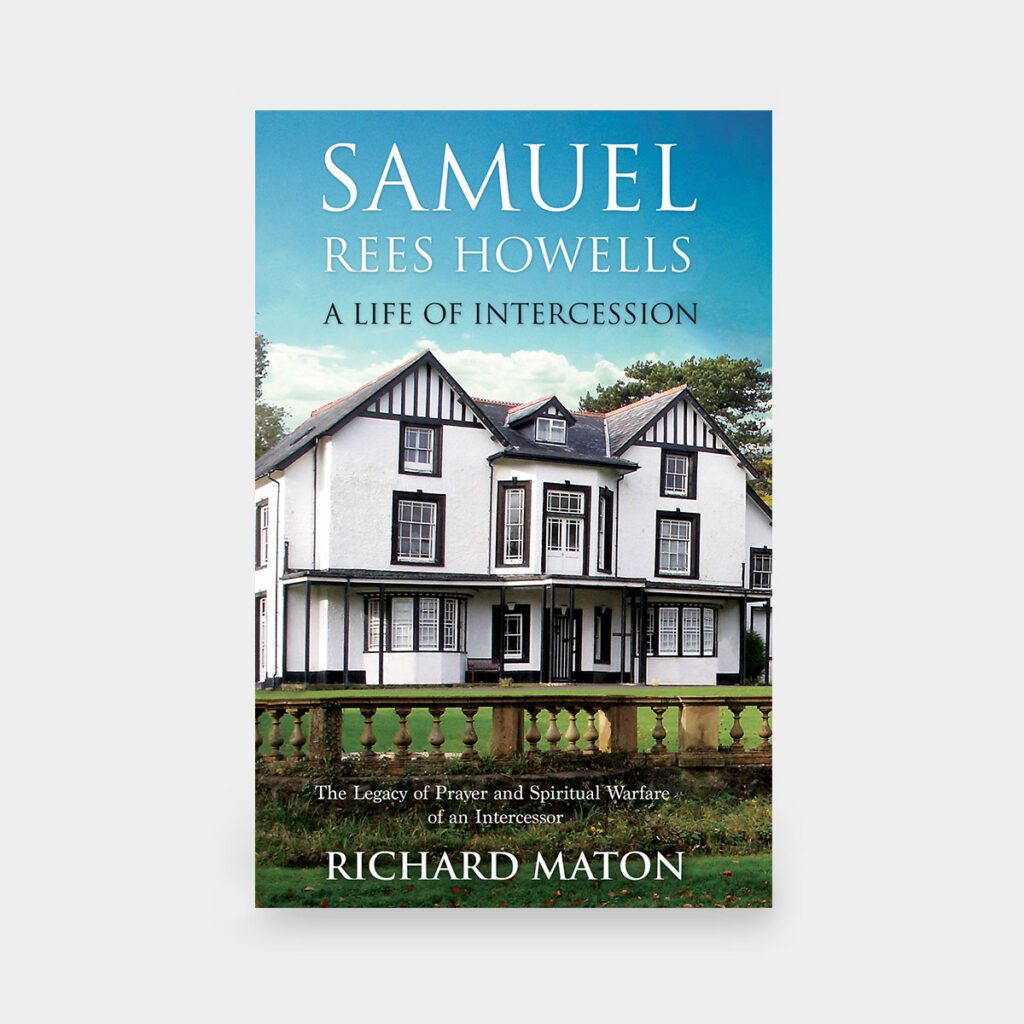
Adapted article by Mathew and Paul Backholer and used with permission from Samuel Rees Howells, A Life of Intercession by Richard Maton and Paul Backholer, edited by Mathew Backholer.
Find out about Rees Howells’ books here.