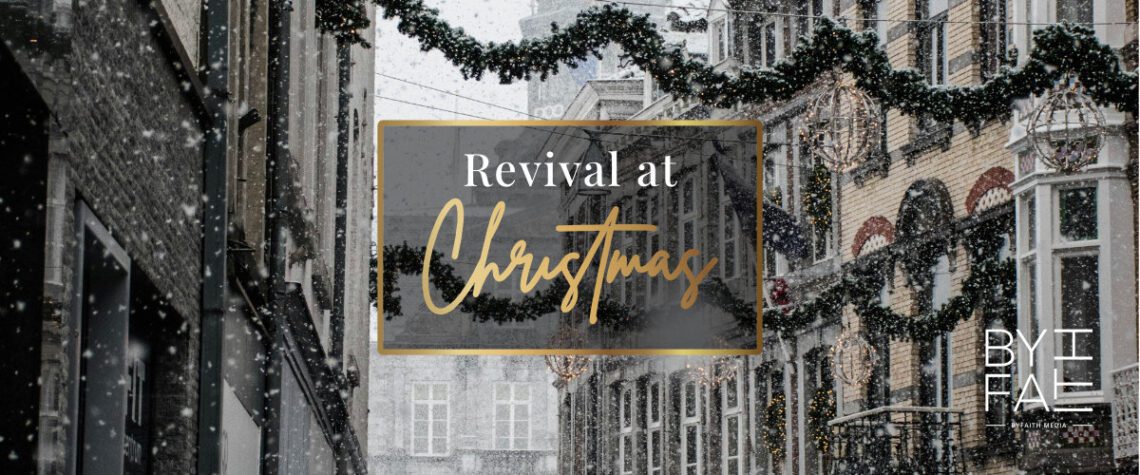
Holy Spirit Revival at Christmas 1851-1974
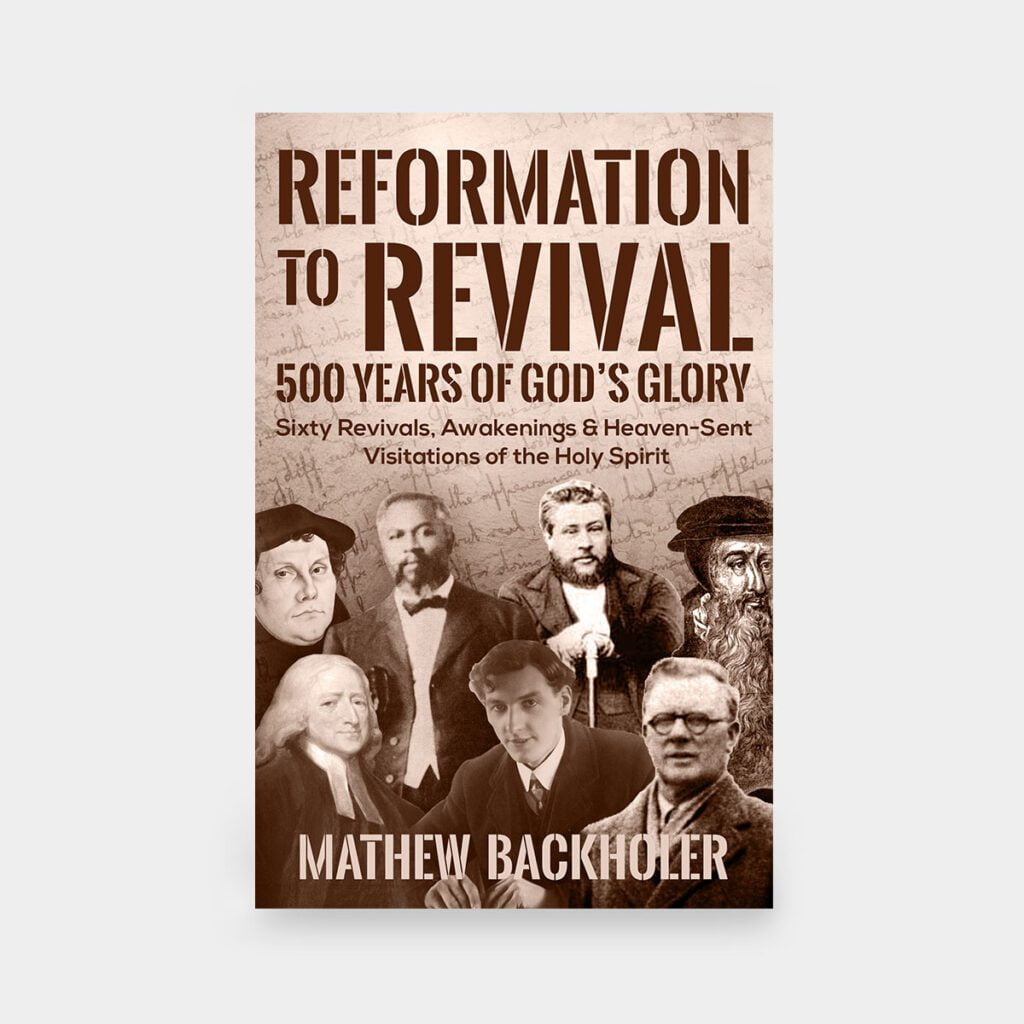
As I was reading Reformation to Revival, 500 Years of God’s Glory it struck me how many occasions there were times of Heaven-sent revival during the period of Christmas and New Year. Revival is the Church being saturated with God – it is primarily intended for the Church so that they can be revived into a true, proper and correct relationship with God. From this, revival begins to affect those who are outside of the Church to a lesser or greater degree. Theologically and historically the river of revival begins amongst the Church (the body of Christ), but will naturally flow outwards and bring to life those who are dead in their trespasses and sins (non-Christians) because God has no pleasure in the death of the wicked. During times of revival, Christians always get revived before sinners get converted because that is a spiritual law of revival.
If My people who are called by My name will humble themselves, and pray and seek My face, and turn from their wicked ways, then I will hear from Heaven and will forgive their sin and heal their land’
2 Chronicles 7:14
Revival is essential for the life and well-being of the Church. Revival glorifies God, vindicates His name, uplifts Jesus, gives the Holy Spirit His rightful place in the Church, raises the high and holy standard of the body of Christ, draws backsliders back into the family of God and saves sinners who become part of the Church.
Baldhu Church Revival 1851-1854 – Cornwall, England
In the summer of 1848, Billy Bray was living near Bodmin, Cornwall in England and he visited the Baldhu Church, nearly thirty miles away, which had been recently completed and consecrated to the glory of God. After the service, he came away disappointed because the parson, Rev. William Haslam was an unconverted High Churchman, as were many of the Church of England ministers of his day. In the afternoon, God told Billy that he had no business there at present and that he had come too soon and without His permission.
Rev. William Haslam was very religious and pious and genuinely believed that the way of salvation was through the Church in obedience to its rituals and sacraments. Each Sunday communion was held and every week he would visit every home in his parish, between twelve and twenty houses each day. He always left tracts, yet was still unregenerate and completely baffled by the meaning of ‘conversion.’
In time, he realised that evangelical tracts from the Religious Tract Society were more ardently read than those on sacramental topics and wondered why his daily services (except Sundays) were often only accompanied by himself. Gradually people from his parish became converted, three of them through reading tracts which he had given them. As Rev. Haslam attended to his pastoral duties, different people used to talk to him about their conversion which he found quite baffling and challenging.
Robert Aitken of Pendeen, a fellow minister who had already seen revival in his parish and a friend of Rev. William Haslam greatly helped him see the light when he stayed at his manse for a few days. Mr Aitken frankly told Rev. Haslam that he was not converted and said that he needed to distinguish between the work of his conscience and the work of the Spirit.
On Sunday, 19 October 1851, Rev. William Haslam, was so ill that he was quite unfit to take the service. Before he knew it, the bells had been rung for service. His clerk took most of the service and then Rev. Haslam stood up and read Matthew 22:42, ‘What think ye of Christ?’ and then thought that he had better give a few words of explanation before dismissing the congregation. During his explanation of the passage, he realised that Jesus Christ had come to save him. He later wrote: ‘I felt a wonderful light and joy come into my soul…’ and was brought to saving faith in Christ Jesus, under his preaching! A local preacher stood up, outstretched his arms and shouted, “The parson is converted! The parson is converted! Hallelujah.” The congregation of three to four hundred went wild in jubilation and praised the Lord.
Rev. Haslam wrote: ‘Instead of rebuking this extraordinary “brawling,” as I should have done in a former time, I joined in the outburst of praise; and to make it more orderly, I gave out the Doxology – “Praise God from whom all blessing flows” – and the people sang it with heart and voice, over and over again. My Churchmen were dismayed, and many of them fled precipitately from the place. Still, the voice of praise went on and was swelled by numbers of passers-by, who came into the church, greatly surprised to hear and see what was going on. When this subsided, I found at least twenty people crying for mercy, whose voices had not been heard in the excitement and noise of the thanksgiving. They all professed to find peace and joy in believing’ and three were from Rev. Haslam’s household; this was the beginning of the Baldhu Church Revival (1851-1854).
At one time in the school-room at Baldhu, there was a continual meeting without cessation for three days and three nights with people constantly coming and going! The first Christmas Day, during the revival (1851), was a wonderful time as the people realised what Christmas was truly about. At the New Year’s Eve service, those gathered dedicated themselves afresh to God’s service. Rev. William Haslam wrote: ‘It was a blessed season, and several hundred were there, who together with myself, were the fruits of the revival during the previous two months. The new year opened upon us with fresh manifestations of Divine power and large blessings.’
Thus says the Lord: “For I will pour water on him who is thirsty, and floods on the dry ground; I will pour out My Spirit on your descendants and My blessing on your offspring”
Isaiah 44:3
Welsh Revival 1904-1905
Daniel Powell Williams of Penygroes, in Carmarthen, South Wales, UK, was converted on Christmas Day 1904 in Lougher. In reference to the revival, he wrote: ‘The manifestation of the power was beyond human management. Men and women were mowed down by the axe of God like a forest. The glory was resting for over two years in some localities.’ Dan Phillips was also converted on Christmas Day 1904 during the revival and went on to found the Apostolic Church, a Pentecostal denomination with more than ten million members in 2017.
In the Rhondda Valley and beyond, the magistrates were given white gloves, a symbol of purity, as there were so few cases to hear; God’s Spirit that brought conviction of sin, which eventually led to salvation as people called upon God, brought about changed lives, sobriety and restraint. White gloves were also handed out in Swansea County Court and Aberdare; whilst Aberdare on Christmas Eve was almost entirely free from drunkenness, and on Christmas Day there were no prisoners at all in the cells. At Abercarn Police Court, responsible for a population of 21,000 there was not a single summons on a Thursday before the New Year – a thing unknown since the Court was formed fourteen years previously, and the ceremony of the white gloves was observed. In Cardiff, the Mayor handed the chief constable a pair of white gloves in memory of there being no cases at all on the charge sheet on the last day of 1904.
The Christian Herald newspaper, dated 16 February 1905, consisted of twenty-four pages, much of which was dedicated to the revival; with illustrations. One of the illustrations showed Father Christmas holding a Christmas tree over his shoulder whilst a husband, wife and three children sat around the meal table. The article stated: ‘The revival in Wales brought many a family a far happier Christmas than they ever had before. The aforementioned drunken husband and father, now made a new man in Christ Jesus, spent the money which had hitherto gone to the public house and in betting, in clothes and feeding his family, and provided such a Christmas treat as they had only before seen in dreamland. No wonder the artist has shown Old Father Christmas looking on with approval.’ This image was also printed on postcards and sold during the revival.
‘O Lord, though our iniquities testify against us, do it for Your name’s sake; for our backslidings are many, we have sinned against You’
Jeremiah 14:7
Pyongyang Great Revival 1907-1910 – Korea
In August 1906, the Pyongyang missionaries met for a week of Bible study and prayer. They invited Dr. R. A. Hardie of Gensan, on the east coast, to lead them, whose public confession and repentance in Wonsan in 1903 was the beginning of the Wonsan Revival Movement (1903-1906). In September 1906, Dr. Howard Agnew Johnston, of New York, America, whilst in Seoul, Korea, informed a group of missionaries and Korean Christians about the Khasi Hills Revival (1905-1906) in India, where 8,200 had been baptised when two women missionaries from the Khassia Mission were influenced by the Welsh Revival (1904-1905) and called for prayer. Jonathan Goforth, a missionary to China, wrote that because of this more than twenty missionaries from Pyongyang Presbyterian and Methodist missions resolved to meet together to pray daily for ‘greater blessings.’ Over the Christmas period the Pyongyang Christians instead of their usual social celebrations met each evening for prayer. The evening prayer ceased at the start of the Pyongyang General Class but continued at noon for those who could attend.
The textbook for the missionaries over the summer period was the First Epistle of John. William Newton Blair wrote that the message became personal and living: ‘We had reached a place where we dared not go forward without God’s presence.’ The missionaries poured out their hearts before Him and searched their hearts whilst seeking to meet the conditions. Before the meeting had ended the Holy Spirit showed those present that ‘the way of victory’ is the way of, ‘confession, of broken hearts and bitter tears.’ They decided to pray for ‘a great blessing’ a revival amongst their Korean Brethren and especially amongst the Pyongyang Bible-study classes for men which would take place in January 1907.
‘I will make them and the places all around My hill a blessing and I will cause showers to come down in their season; there shall be showers of blessing’
Ezekiel 34:26
Indonesian Revival 1964-1974 – Indonesia
The Indonesian Revival is perhaps the most supernatural revival the world has ever seen – truly of biblical proportions with many personalities involved. During the revival, Muslims were affected as were nominal Christians and the animists or heathen. Indonesia has more than 13,400 islands; more than 8,800 are named, though there are many tidal islands and rocky reefs which appear at low tide. More than 920 of the 13,400 islands are inhabited, some are only inhabited at certain times of the year.
The vast majority of miracles took place on the Island of Timor, in the first five years of the revival, on the eastern extremity of the Indonesian archipelago. For this reason, this revival though not confined to Timor, is sometimes referred to as the Timor Revival (1965-1974). It started a year later than in other places in Indonesia and continued for three years longer, though the afterglow in many places was still strong after these dates.
A Holy Spirit movement began on the Island of Rote, also known as, Roti, south of Timor in 1964, as the word of the Lord was preached. Two men, Pak Elias and Pastor Gideon (who first met in 1966) were both figures at the forefront and natives of Rote. Prayer groups sprang up which became the backbone of the revival. As they preached the saving message of the cross, the locals became overwhelmed by their sins and called on the Saviour, Jesus Christ, and within a year a thousand people had been converted.
On the island of Sumatra, a thousand miles away, God began a work amongst the Muslim ‘poison mixers’ on the southern tip. Their tribal leader, Abram, had finished attending a Communist educational course and heard the Nativity story through an open window of a church whilst a Christmas sermon was in progress. Abram decided to tell his people about the story of Jesus and sent a letter to some Christians asking for help as his people wanted to hear more about the Christ-child. The help duly arrived and within five years, 1,500 were converted. Glory to God, peace on earth and goodwill to all mankind.
‘Oh, that You would rend the heavens! That You would come down! That the mountains might shake at Your presence’
Isaiah 64:1
Used with Permission from Reformation to Revival, 500 Years of God’s Glory by Mathew Backholer.
By Mathew Backholer. Find more about Mathew’s books here.